We are an approved North Carolina Department of Insurance education provider (Provider ID# 10017514). Satisfy your continuing education requirements without interrupting your business or visiting a classroom. Instead, train At Your Pace Online with high-quality, internet-based Insurance Producer CE classes. We offer great courses at great prices for North Carolina professionals. Our classes are easy to use and give you around-the-clock access to course material as soon as you sign up. Once you finish your course, we'll report your credits to North Carolina for no extra fee.
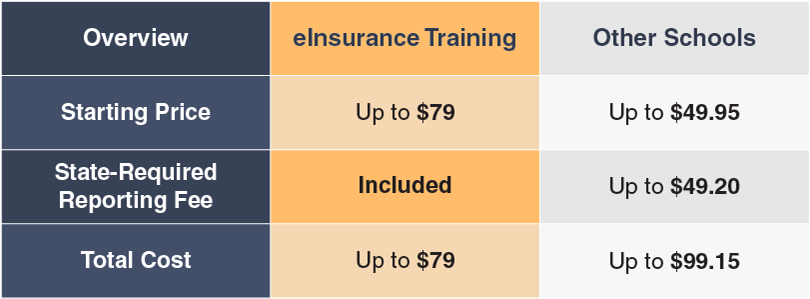
Pricing is based on 24-hour packages.
24 Hour Life and Health Review with Ethics
 24h course
Includes the $49.20 reporting fee.
This 24 hour continuing education course is designed to help insurance producers renew their licenses. The course is broken into three parts that focus on ethics, life insurance, and health insurance. The ethics portion discusses the concept of ethics and what it means to operate in an ethical manner. The life insurance portion discusses such topics as uses of life insurance, types of life insurance, policy provisions, annuities, and qualified retirement plans. The health insurance portion covers a number of topics including health insurance fundamentals, health insurance policies, disability coverage, group health insurance, and long term care insurance.
27 Hour Property and Casualty W/ NFIP
27h courseIncludes the $55.35 reporting fee.
This course provides 27 hours of CE, and will cover key principles of Property & Casualty insurance. In addition to reviewing core concepts of P&C insurance, this course includes 3 hours of ethics, 3 hours of NFIP education, and the mandatory exam. No additional reporting fees.
24 Hour Property and Casualty Review
24h courseIncludes the $49.20 reporting fee.
The focus of this continuing education course is property and casualty insurance. By completing this course, an insurance producer will gain 24 hours of instruction that can be applied toward license renewal. This course discusses a number of topics including professional ethics, dwelling and homeowners insurance, automobile insurance, insurance for business owners, and workers’ compensation insurance.
Note - This course does not include NFIP. If you need your NFIP requirement this renewal cycle, take our 27 hour Property & Casualty w/ NFIP course.
8 Hour Initial LTC Continuing Education Course
8h courseIncludes the $16.40 reporting fee.
This eight-hour course applies to producers who need to earn their initial certification in order to transact long-term care (LTC) insurance. This course will cover key principles and concepts related to long-term care insurance coverage and will discuss a number of important issues surrounding long-term care, including an introduction to the history and concepts related to LTC, what long-term care insurance is and its associated uses, levels of care, eligibility for coverage, settings for care, the Activities of Daily Living, alternatives such as Medicare, Medigap and Medicare Advantage plans, and Medicaid.
The course continues with a deep look at long-term care policies, including the basics and in-depth material. Elimination periods, general underwriting, benefit periods, tax issues and tax-qualified contracts, agent and insurer responsibilities, replacement concerns, optional benefits and riders are thoroughly explored. The last sections of the course detail the National Association of Insurance Commissioners Long-Term Care Model Act and its requirements.
The course contains numerous illustrations and graphics to assist comprehension, as well as simplifications of difficult laws and rules.
The course concludes with a final exam that must be successfully passed in order to receive certification for the course.
4 Hour Long-Term Care Ongoing CE
4h courseIncludes the $8.20 reporting fee.
This four-hour course applies to producers who need to complete their Long-Term Care (LTC) refresher course in order to maintain their ability to sell Long-Term Care insurance. This updated course will cover key principles and concepts related to long-term care insurance coverage and will discuss a number of important issues surrounding long-term care, including an introduction to the history and concepts related to LTC, what long-term care insurance is and its associated uses, levels of care, eligibility for coverage, settings for care, the Activities of Daily Living, alternatives including Medicaid and life insurance riders, and important sections of the National Association of Insurance Commissioners (NAIC) Model Long-Term Care Act and changes.
3h courseIncludes the $6.15 reporting fee.
This course discusses many different topics surrounding ethical practices, such as ethics versus morals, ethics in practice, ethical decision-making models that illustrate how ethical dilemmas may be solved, and the terminology used in ethics, such as tort law, equity, and more. The course will assist the student in making the proper ethical decisions, provide examples of poor ethical choices, and the legal enforcement of ethics.
3h courseIncludes the $6.15 reporting fee.
This course provides the Mandatory 3 hour Education Requirement to sell Flood Insurance! This course will also count for 3 hours of general continuing education if you do not sell Flood Insurance. No additional reporting fees.
Residents of North Carolina must complete continuing education requirements in order to renew their insurance licenses. Both insurance producers and insurance adjusters must complete 24 hours of continuing education biennially. Three of those hours must be designated as belonging to ethics courses
Depending on your specific branch of insurance, you may have additional specific courses you are required to take. These specific courses also count toward your CE requirements
Up to four hours of continuing education hours each term may come from participating in approved professional industry or national industry organization meetings. All other continuing education hours must come from:
In order to meet North Carolina CE requirements, non-residents must meet their home state's continuing education requirements. As long as the requirements in their home state are generally similar to those in North Carolina, the licensee is considered to be in compliance with North Carolina CE requirements.
Any excess continuing education hours can be carried over into the next term. Excess ethics or flood training hours are carried into the next term as general hours, not as ethics or flood hours. This ensures that ethics and flood training are happening regularly
Insurance licenses are good for a maximum of two years. License renewal dates are based on the licensee's birth date rather than on the date the licensee originally filed for their insurance license
Licenses expire at the end of the licensee's birth month. If you were born in an even year, your license always expires in even-numbered years, while if you were born in an odd year, your license always expires in odd-numbered years
Producers in the following lines will see their licenses automatically renew as long as they meet their continuing education requirements:
However, if licensees in these lines fail to meet continuing education requirements by the deadline, their licenses will expire. Producers with expired licenses have 4 months to meet the continuing education requirements. To have their licenses reinstated, they must also pay a $75 reinstatement fee
If the four-month deadline passes, the producer would need to undergo their pre-licensing and state exam again before obtaining a new license
Producers with other lines must file online to renew their insurance licenses after fulfilling all continuing education requirements.
Courses that are taken in person and webinar courses do not require an exam. Attendance and participation in the whole course are all that is needed to have those credits count toward the CE requirements for a particular term.
However, for online and self-study courses, passing an exam is required. All exams are closed-book, meaning course materials are not permitted to be accessed while taking the exam
Online courses do not require a monitor. For self-study courses, licensees are required to have an impartial monitor who is neither a family member nor has any financial stake in the exam's results.
All exams must be passed with a score of 70 percent or higher in order for credit for the course to be applied. Examinees are allowed to take an exam an unlimited number of times until they pass
While it is possible for you to take the same course more than once in a reporting period for your own benefit, you may not count the second pass of the course toward your continuing education requirements. However, you may take the same course multiple times in different reporting periods as long as you're not using the repeated course as part of carried-over credit hours
Instructors may receive the same credit for teaching a course as their students receive for attending the course. Just as with students, instructors can only receive credit for a course they teach once in a reporting period
Once a course has been completed, it must be reported to the state within 15 days. The agent's NPN is needed to report course completion. The North Carolina Department of Insurance charges $2.05 per reported credit hour as a roster fee, which is automatically charged to the last credit card used on your account
You may be exempt from North Carolina's continuing education requirements if active-duty military service or long-term illness keeps you from being able to complete continuing education requirements. However, even in the case of active-duty military service or long-term illnesses, LTC training requirements must be maintained. Contact the North Carolina Department of Insurance directly to assess your eligibility for an exemption.
All adjusters, as well as property, casualty, and personal line producers are required to complete NFIP Flood Insurance Certification Training before selling, soliciting, or negotiating flood products or policies. They must retake these hours every other term after their initial training has been completed
These training requirements can count toward regular continuing education requirements for the term in which they are complete. However, any extra flood requirements at the end of a term carried over to the next term as general credits, not as flood credits.
New applicants for licensure must hold the following licenses before they can sell in NC:
1. Accident & Health and/or Sickness
2. Medicare Supplement/Long Term Care
Long-term care (LTC) producers are required to complete an eight-hour LTC certification training before selling, soliciting, or negotiating LTC insurance products or policies. Additionally, LTC producers must complete four hours of continuing training every other term
These training requirements can count toward a licensee's regular continuing education requirements for the term in which they are completed.
