We are an approved continuing education provider by the Massachusetts State Division of Insurance (Provider ID# S16982). All of our courses can be completed At Your Pace Online, and never include any hidden fees. We strive to offer the best value in online continuing education!
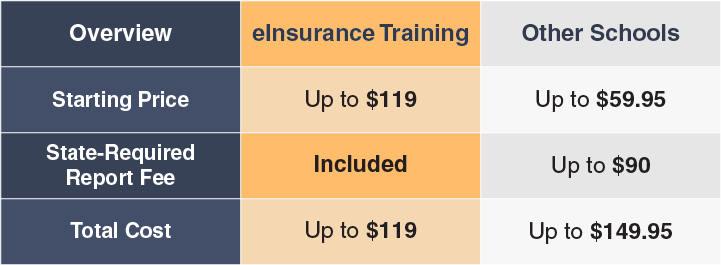
Once you complete one of our online courses, we will report your course completion directly to the Department of Insurance (DOI) for you at no additional cost. The reporting fee for Massachusetts is $1.50 per CE hour.
Due to state requirements, courses cannot be retaken for credit within 36 months of the original completion date.
Pricing is based on 60-hour packages.
60 Hour Life & Health Initial Renewal Package
 60h package
This package satisfies the full 60 hours of CE for those renewing for the first time, and includes the required 3 hours of ethics training. The majority of the content applies to Life and Health topics.
Includes the $90 state reporting fee.
60 Hour Property & Casualty Initial Renewal Package
60h packageThis package satisfies the full 60 hours of CE for those renewing for the first time, and includes the required 3 hours of ethics training. The majority of the content applies to Property and Casualty topics.
Includes the $90 state reporting fee.
45h courseThis course provides ALL 45 hours of CE that you need! This course will review key concepts and principles of Life & Health insurance. It includes 42 hours of general content and 3 hours of Ethics content.
Includes the $67.50 state reporting fee.
45 Hour Property & Casualty Review
45h courseThis course provides ALL 45 hours of CE that you need! This course will review key concepts and principles of Property and Casualty insurance. It includes 42 hours of general content and 3 hours of Ethics content.
Includes the $67.50 state reporting fee.
42h courseThis course will review key concepts and principles of Life & Health Insurance. This course provides 42 hours of education on Life & Health topics, and the mandatory exam.
Includes the $63 state reporting fee.
42 Hour Property & Casualty Review
42h courseThis course will review key concepts and principles of Property & Casualty Insurance. This course provides 42 hours of General Property and Casualty content and the mandatory exam.
Includes the $63 state reporting fee.
8 Hour Initial LTC Continuing Education Course
8h courseThis eight-hour course applies to producers who need to earn their initial certification in order to transact long-term care (LTC) insurance. This course will cover key principles and concepts related to long-term care insurance coverage and will discuss a number of important issues surrounding long-term care, including an introduction to the history and concepts related to LTC, what long-term care insurance is and its associated uses, levels of care, eligibility for coverage, settings for care, the Activities of Daily Living, alternatives such as Medicare, Medigap and Medicare Advantage plans, and Medicaid.
The course continues with a deep look at long-term care policies, including the basics and in-depth material. Elimination periods, general underwriting, benefit periods, tax issues and tax-qualified contracts, agent and insurer responsibilities, replacement concerns, optional benefits and riders are thoroughly explored. The last sections of the course detail the National Association of Insurance Commissioners Long-Term Care Model Act and its requirements.
The course contains numerous illustrations and graphics to assist comprehension, as well as simplifications of difficult laws and rules.
The course concludes with a final exam that must be successfully passed in order to receive certification for the course.
Includes the $12 state reporting fee.
4h courseThis four-hour training course is designed to meet the National Association of Insurance Commissioners’ (NAIC) education requirements for producers authorized to sell annuities. Specifically, this course includes the 2020 updates to the NAIC’s amended Model Regulations for annuity transactions. This course covers annuity suitability and best interest laws, as well as in-depth information on types of annuities, understanding each party of an annuity, contract structures, recordkeeping, contract provisions, and more. This course will teach students how to help a customer choose an annuity product that is right for them, and how to do so lawfully.
Includes the $6 state reporting fee.
4h courseThis four-hour course applies to producers who need to complete their Long-Term Care (LTC) refresher course to maintain their ability to sell Long-Term Care insurance (LTCi). This updated course will cover key principles and concepts related to long-term care insurance coverage and will discuss a number of important issues surrounding long-term care, including an introduction to the history and concepts related to LTC, what long-term care insurance is and its associated uses, levels of care, eligibility for coverage, settings for care, the Activities of Daily Living, alternatives including Medicaid and life insurance riders, and important sections of the National Association of Insurance Commissioners (NAIC) Model Long-Term Care Act and changes.
Includes the $6 state reporting fee.
3h courseThis course applies to producers in all lines. It includes Ethics for Insurance Producers. This course satisfies the 3 hour ethics requirement for all Massachusetts insurance producers.
Includes the $4.50 state reporting fee.
3h courseThis course includes NFIP Review for Insurance Producers. This course satisfies the 3 hour NFIP training required for Flood Insurance producers in MA.
Includes the $4.50 state reporting fee.
Resident producers must complete a minimum of 60 hours of Massachusetts-approved producer-specific CE subjects during their first triennial (three-year) license term, three credits of which must be in approved ethics subjects (coded as MAE.)
After this initial three-year period, licensees must complete 45 hours of CE credit during each three-year renewal period. Except for the mandatory three hours of ethics courses, there are no subject requirements for these 45 producer CE hours. However, Massachusetts encourages licensees to take at least one credit hour of CE for each line in which they are licensed
Resident adjusters are required to fulfill 15 hours of insurance adjuster-specific CE coursework in their first three-year term and again each subsequent triennial renewal period. Three of these hours must be in Massachusetts-approved ethics courses
CE coursework may be conducted in a classroom, online, or through self-study. Courses provided by national programs such as CPCU, CLU, CIC, and AAI are accepted toward this CE requirement.
Additional guidelines to this CE requirement exist for licensees who sell specific products, including:
Non-residents who are in compliance with their state's CE requirements are exempt from completing Massachusetts CE. However, if a licensee's home state does not have CE requirements — or those requirements do not meet the standards for the license type or line of authority in Massachusetts — the licensee will have to complete the associated CE requirements in Massachusetts
Producers are encouraged to complete additional CE training. Up to 45 credit hours may be carried over to the next renewal period. Excess CE hours earned by resident adjusters may not be carried into the next term
License expiration dates occur on the last day of the licensee's birth date triennially (every 3 years), based on the year of original licensing
Renewals may be submitted via paper to the Massachusetts State Division of Insurance or electronically at the NIPR website. Alternatively, licensees may use the Massachusetts State Information Center Insurance Licensing Search and Renewal Tool. Licensees are eligible to renew from 60 days prior to their license expiration date
The license renewal fee is:
Fees are waived for veterans and the legally blind. Producers holding LOAs in casualty, property, or personal lines are charged an additional $75 lead paint surcharge fee
Producers who fail to meet their CE compliance requirements will not have their license renewed, but there is a one-year reinstatement period during which they can make up missing requirements. The producer reinstatement fee is $450
There is no reinstatement period for public adjusters who fail to meet the requirements to renew their licenses. Failure to meet renewal requirements will mean the adjuster must retake the PIA exam and apply for a new license
Certification exams are closed book, and students are not permitted to access course materials during the exam. All exams must be monitored by a non-biased third party who will complete a Declaration of Compliance. This document confirms an understanding of and adherence to state insurance requirements and ensures the legitimacy of the exam results. Family members, friends, coworkers, or any individuals with a financial interest in the exam-taker's success may not act in this monitor role.
For licensees taking online exams, the Declaration of Compliance must be received by the course provider within nine days to ensure timely reporting to the state of Massachusetts
A score of 70 percent or higher is required to receive the CE credit. Unlimited retakes are permitted until a passing score is achieved
Courses may not be repeated for CE credit toward renewal requirements within three years of the original course completion date
CE course instructors are eligible to receive the same credit as the students enrolled in the course they teach. Instructors are only eligible to receive credit for teaching the same course once per renewal period
Credits must be reported within 10 days of course completion. Proof of completion should be submitted to the state directly by the course provider. Licensees must keep a copy of each certificate in their files for five years
Massachusetts recommends that licensees complete all CE at least 30 days prior to the license expiry date to give the CE provider sufficient time to report successful completions to the Massachusetts Division of Insurance. However, CE courses can be completed at any time within the current license term
Some resident licensees may qualify for full or partial CE exemptions, including:
The Continuing Education Course Review Committee of Massachusetts may also waive some CE requirements for student graduates in upper-level university programs including business, accounting, management, mathematics, or financial planning. Qualified licensees are required to contact the Massachusetts Insurance Division for a waiver application
Producers intending to sell, solicit, or negotiate annuity products or group variable products in Massachusetts must obtain a license to do so
The licensing requirements include:
If you were licensed on or after June 1, 2023, you must complete a one-time, 4-hour annuity best interest course before selling, soliciting, or negotiating annuity products in Massachusetts.
Producers selling long term care (LTC) products in Massachusetts must complete a one-time, state-approved training course consisting of a minimum of eight hours.
Following this initial training, producers selling LTC products are required to complete four hours of LTC training every 24 months. This four-hour training must be completed within 24 months after completing the initial eight-hour course. Ongoing training contributes toward a licensee's CE renewal requirements
Producers who have completed Division-approved LTC training in another state must complete a two-hour LTC training course specific to MassHealth requirements. This standard applies to both the initial training course and the ongoing training.
Licensees who intend to sell flood insurance must follow national guidelines. In order to sell flood insurance, the individual must complete a one-time minimum of three training hours as outlined by the National Flood Insurance Program and FEMA. This may be completed in any state in which the producer is licensed.
